Marshals, Mud and Movement: The Saturday Shift That Counts as Training
Most exercise logs are honest but narrow. They record the run, the class, the gym session. They tend to miss the hour you spent standing at a corner in a hi-vis jacket, walking backwards along a finish funnel and carrying a box of tokens to a table. Parkrun volunteering is usually described as putting something back into the community. It is that. It is also a movement session with a social side, and for plenty of UK readers it is the most repeatable Saturday workout on the calendar.
Why volunteering counts as movement, without over-selling it
Let us be clear: marshalling is not a replacement for a hard training block. It will not build your squat by itself. But it does add the kind of movement that modern life quietly removes: walking at an easy pace, standing on uneven ground, bending to pick things up, carrying lightweight kit, turning, pointing, shuffling and waiting. That is not nothing. For anyone who spends Monday to Friday sitting at a desk, an hour on their feet in a local park is a useful deposit in the movement bank.
The other thing it does is make movement social. You are outside, among people, with a small job to do. That matters in November, when the sofa has a strong case and the duvet is lobbying hard.
The roles, from a movement point of view
This is not a strict ranking. It is a rough guide to what each job asks of your body.
Tail walker. You walk the course at the back, usually with the final participants and sometimes with a friend or a dog. It is the closest thing to a straightforward walking session on the volunteer roster. Expect 45 to 70 minutes on your feet, depending on the course and the pace. If your goal is walking volume, this is the role to ask for.
Course set-up and pack-down. This is the carrying and bending shift. Signs, cones, stakes, maybe a table or a box of kit. You will walk, lift, lower, reach and squat. None of it is heavy in isolation, but it adds up to a genuinely useful strength-and-mobility session if you do it regularly. It is also a good way to learn the course.
Marshal. A marshal stands, points, claps and occasionally walks a few steps to check on someone. On paper it looks static. In practice, standing in a cold park for 45 minutes is its own challenge. You will use your balance on muddy ground, you will shift your weight, and you will feel your calves by the time you get home. Wear more layers than you think you need.
Funnel manager. This role involves side-stepping, shuffling, directing people and keeping the finish area calm. It is low-intensity but surprisingly good for balance and coordination, especially when the ground is wet and everyone is arriving at once.
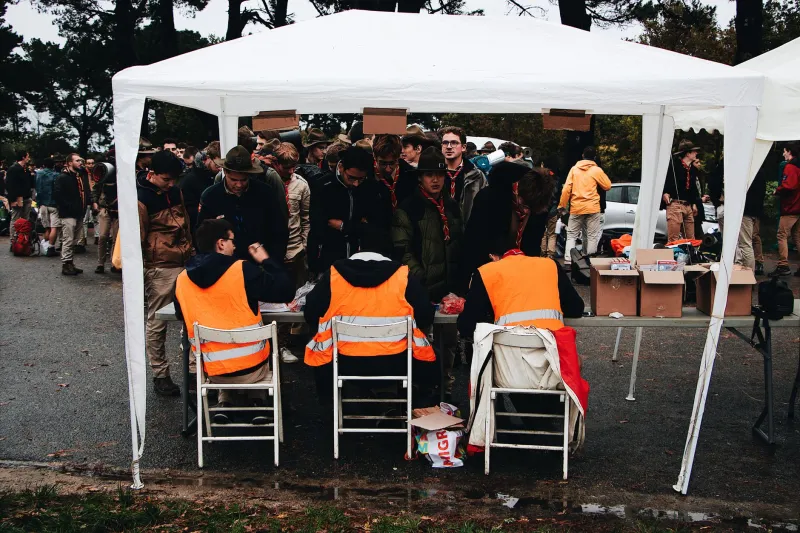
Barcode scanning. You stand, reach, hold a phone or scanner and take small steps. It is not a workout in the traditional sense, but it keeps you on your feet and talking to people. If you want a low-demand entry point, this is a good one.
Token sorting. This is mostly seated fine-motor work. It is not a movement session. It is, however, a useful job for a cold or rainy day, for anyone who needs a seated role, or for a family member who wants to help without walking the course. Not every volunteer shift has to be a training session.
The winter version is a different beast
A summer marshal stint can feel like a gentle morning out. A winter one asks more of you. The ground is colder, the light is lower, and standing still in a slight wind can chill you faster than walking. Treat it like a session: check the forecast, wear layers you can move in, bring gloves, and take a flask. If you are on a static role, walk a few laps of the park before the start and again afterwards. It sounds fussy. It is just good sense.
It also helps to think about what you are not doing. You are not trying to get a personal best. You are not squeezing in a fifth training day. You are adding movement volume, community contact and a reason to be outside. That is a decent Saturday morning.
A low-commitment plan for trying one shift
- Look up your local event and find the volunteer page or email. Ask what roles are open and say you are new. Most volunteer teams are glad of the help and will explain the job.
- Pick a role that matches your current goal. Want more walking? Ask about tail walking. Want carrying and bending? Ask about set-up or pack-down. Want something low-key? Ask about barcode scanning or token sorting.
- Treat the shift as a movement session. Walk there if you can, do five minutes of easy mobility before you start, and layer up. If you are standing still, plan a short walk afterwards so you do not spend the rest of the day stiff.
- Do not stack it on top of a hard session if you are already tired. Standing in the cold is more taxing than it looks. Give yourself permission to make it the main movement of the day.
- Count it honestly. You might get 3,000 to 6,000 steps, 45 to 60 minutes on your feet and a bit of carrying. That is a useful addition, not a replacement for strength work or a proper cardio session.
- Try it once. Then decide whether it fits your week. The beauty of volunteering is that you can do it regularly, occasionally or just when the roster looks short.
The social bit is not a side note
The health benefit of parkrun volunteering is not just about steps. It is the reason to leave the house in November, the names you learn, the regulars you nod to, the small talk that turns a cold corner into a familiar place. That is the part that keeps people coming back. Movement is easier when it has a purpose and a few friendly faces attached.
The smartest Saturday workout might not look like one. It might look like a hi-vis jacket, a thermos and a muddy corner of a local park. Try one shift this winter. Your legs will notice, your calendar will thank you, and the event will be glad of the help.