Ten Thousand Steps Is a Floor, Not a Ceiling: The Movement Variety Score Worth Trying
Photo: Unknown, CC0, via Wikimedia Commons
Somewhere along the way, 10,000 became the number. Not a guideline, not a suggestion, but a daily pass-or-fail mark that follows us from phone lock screens to workplace step challenges. Walking is brilliant. It is free, low-impact and easy to squeeze into a British day between rain showers. But it is also just one flavour of movement, and treating it as the whole meal is a bit like eating only toast because toast is easy to count.
How walking became the whole story
Pedometers made steps visible, then phones made them unavoidable. A step target fits neatly into a spreadsheet and an office leaderboard. It is also easy to sell: put one foot in front of the other, repeat. There is nothing wrong with that. Walking supports cardiovascular health, mood and everyday function. But step counts tend to reward quantity over range. Most of those steps happen in a fairly narrow movement pattern, and they do not ask much of your upper body, your hips at the end of their range, or your balance.
The result is a strange kind of fitness culture where someone can hit 12,000 steps and still feel stiff when they get off the floor, or skip strength work entirely because the watch says they have already won the day. Steps are a useful metric. They are just not the only one.
What a movement variety score actually is
A movement variety score is not a fitness test and it is not a training programme. It is a simple weekly tally of how many different kinds of movement you have done. No pace, no heart rate, no calorie estimate. Just five broad flavours:
- Strength: carrying, pushing, pulling, squatting or hinging against some kind of resistance.
- Mobility: reaching, twisting, kneeling, sitting on the floor, moving joints through a comfortable range.
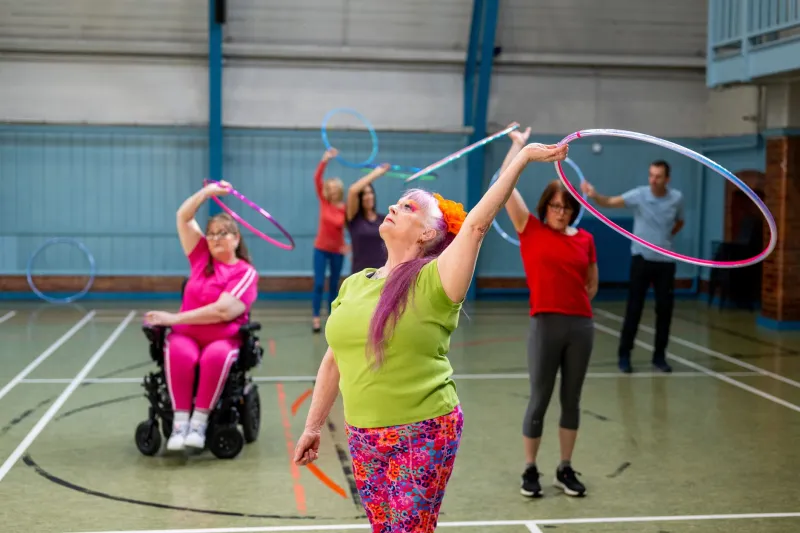
- Balance and coordination: standing on one leg, dance, tai chi, throwing and catching, anything that asks your body to organise itself in space.
- Outdoor movement: time outside, ideally with some walking or cycling, for daylight and terrain as much as steps.
- Play or social movement: a class, a kickabout, a swim with a friend, a kitchen disco, something done for enjoyment rather than accounting.
Give yourself one point for each flavour you include at least once in a week. That is it. A maximum of five. You could hit three in a single afternoon or spread them across seven days. The score is deliberately forgiving.
Why bother with five flavours?
Because most of us default to the movement we already find easiest. Variety nudges you towards the things that slip. Strength work is the classic omission: UK physical activity guidance already suggests adults do strengthening activities twice a week, and balance work becomes more important as we get older. Neither tends to happen by accident. Mobility is similar. You can walk every day and still never reach overhead, rotate your spine or spend time in a deep squat.
Variety also makes movement more interesting, which matters more than any score. A dance class, a garden tidy-up and a set of carries all count, but they feel completely different. That difference is the point. It keeps the week from becoming a single repeated note.
Keeping score without another gadget
You do not need an app. A five-box grid on the fridge, a note in your phone or a scrap of paper by the door is enough. At the end of the week, ask two questions: which flavours showed up, and which went missing? That is the whole review.
If you miss a week, the score resets. It is a prompt, not a performance review. The moment it starts feeling like a stick to beat yourself with, it has stopped doing its job. The aim is curiosity: oh, I have not done anything strength-related for ten days. What would be easy to add?
Fitting variety into an ordinary British week
This does not require a gym membership or a clear diary. It requires a bit of habit stacking.
For strength, carry the shopping the long way to the car. Do a few sit-to-stands while the kettle boils. Keep a resistance band near the telly and use it during ad breaks. For mobility, reach overhead while waiting for the bus, sit on the floor during a podcast, or do ten minutes of yoga before bed. For balance and coordination, put the radio on and dance in the kitchen, book a social dance class at the local hall, or stand on one leg while brushing your teeth. For outdoor movement, take a lunchtime loop even in drizzle, cycle to the shop, or potter in the garden. For play and social movement, join a village hall class, volunteer at parkrun, or swim with a friend.
None of these are heroic. That is the point. A movement variety score is built from small, repeatable things that fit around work, family and British weather.
What the score is not
It is not a competition, a diagnosis or a replacement for medical advice. If you have a health condition, are pregnant, or are returning from injury, adapt the flavours to your circumstances and seek proper guidance. It is also not a reason to abandon walking. Keep the steps if they motivate you. Just do not let them crowd out everything else.
A sample week that is not perfect
Monday: fifteen minutes of bodyweight strength. Tuesday: a brisk walk at lunch. Wednesday: a dance class. Thursday: work ran late and nothing happened. Friday: carried the weekly shop home. Saturday: a longer walk in the park. Sunday: rest.
That week scores three out of five: strength, balance and coordination through dance, and outdoor movement. Mobility and play are not really there, unless the dance class counted as play. It is still a good week. Next week, a ten-minute mobility routine before bed would nudge it higher without changing much else.
The point is not the number
Step counts measure quantity. A movement variety score measures range. One is not better than the other; they simply answer different questions. If your watch has convinced you that walking is the only movement that counts, try a week of five flavours instead. Keep the pen by the door, tick the boxes, and see what your step count has been quietly leaving out.
Move well, feel strong, keep moving.