The Pool Is the Gym: Inside Britain's 7am Aqua Aerobics Class
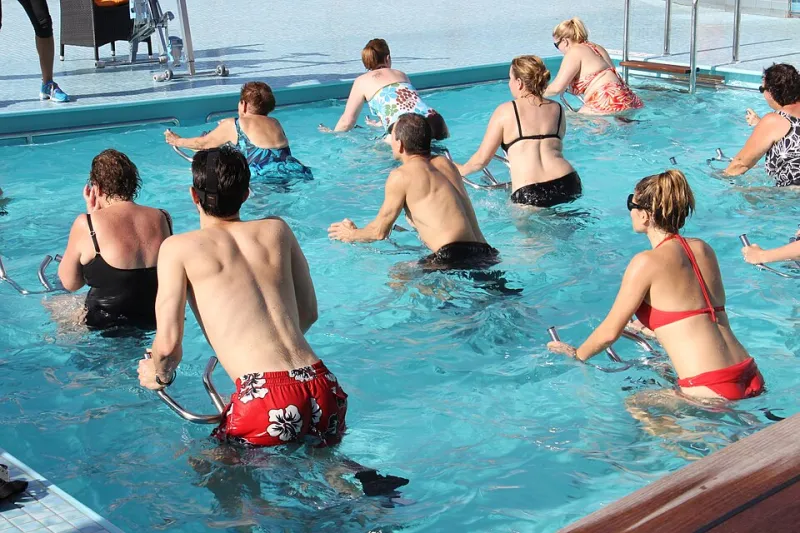
Photo: Gary Bembridge, CC BY 2.0, via Wikimedia Commons
At 6.52 on a Tuesday morning, the leisure centre car park holds eleven vehicles and one extremely committed cyclist. The lights are on. Somewhere behind the double doors a trolley of foam noodles is being dragged into position. By seven o'clock there are twenty-two of us on the poolside, half of us blinking, all of us in swimwear, and the shallow end is about to become a strength studio.
Nobody here is being seen. That is, quietly, the point.
Forty-five minutes, one voice on the side
A standard UK session runs 45 minutes. Warm-up first, usually a march or a jog across the shallow end with big arm swings, then travelling work, then a block with noodles and floats, then a cool-down that is essentially everybody moving slowly backwards while the instructor says the word 'lovely' a lot. The music comes from a speaker that has clearly seen things.
The instructor stays on the poolside. They demonstrate with their arms, shout encouraging things over the acoustics, and occasionally do something alarming with their shoulders to indicate a movement you'll be attempting in a minute.
The content will be familiar if you've ever been to a gym class: squats, press-ups, leg raises, chest presses, core work, a bit of cardio. The difference is that none of it lands. There is no floor to thump against, no weights to rack, no mirror wall to compare yourself with.
Why water is a serious training partner
Water is roughly 800 times denser than air, which means every movement meets drag. Push your arm forward and the water resists; pull it back and the water resists again. Unlike a dumbbell, which is heavy on the way up and helpful on the way down, water demands force in both directions. That's why a set of noodle presses can leave your triceps complaining two days later.
Buoyancy is the other half of the deal. Standing chest-deep, you're supporting maybe a third of your body weight, which takes load off knees, hips and ankles. Anyone with cranky joints or a history of impact injuries tends to find that liberating rather than easy.
It isn't the same as lifting, and it isn't pretending to be. The balance challenge is different, because you're not fighting gravity so much as instability. And because cool water carries heat away from the body, you can work at a decent intensity without overheating, which is precisely how people end up underestimating their own effort. Turn up expecting a gentle splash and you'll be surprised by how much you've done.
The people in the shallow end
The regulars are not one group. There are the runners with furious Achilles tendons, sent here by a physio. There are people six weeks out from a knee replacement. There's a pair of twenty-somethings who came for a joke and stayed for the shoulders. There's a couple who've been attending since 2011 and know the choreography better than the instructor, which they are not shy about.
In 2026 the timetable at most council-run centres is quietly full of these sessions, often under the names Aquafit, Aqua Fit or Aqua Aerobics, and often at hours that suit nobody except the people who actually go. It suits anyone who wants to build or hold onto strength without the gym floor's particular flavour of intimidation: the mirrors, the queue for the rack, the unspoken dress code, the bloke doing lunges at you.
Where the strength actually comes from
Look at a typical class and you'll find the same handful of reliable pieces of work. Press-ups against the pool wall load chest, shoulders and triceps, and the water adds resistance on the way back. Noodle presses, done slowly, are a genuinely hard chest and arm exercise if you commit. Leg raises while braced on the side work hip flexors and core. The 'bicycle' hits hips and abdominals in a way that flatters nobody's ego.
Some classes head into the deep end with flotation belts for running and tuck jumps, which is where the core demand really ramps up. Others stay shallow throughout, and mixed sessions do a bit of both.
Progression is refreshingly simple. More surface area means more drag, so hand paddles or resistance gloves make everything harder; slow the movement down and it gets harder again; move into deeper water and you've added an instability challenge. Ask the instructor before you borrow any kit from the trolley. As a rough effort guide, you should be able to speak in short sentences throughout. If you can sing, push harder. If you can't say four words in a row, ease off.
Your first session: the practical bits
Ring the centre beforehand. Some classes are bookable, some are drop-in and cash on the door, and some fill up. Ask whether it's shallow end, deep end or mixed, and whether a belt is provided if it's the deep end.
Kit list: costume, towel, a pound coin or padlock for the locker, flip-flops, a water bottle and a warm layer for afterwards. Leisure centre changing rooms in November are a law unto themselves and you will be cold before you find the hairdryer.
Tell the instructor it's your first time before you get in. It's the single most useful sentence you can say in the building, and it usually earns you a spot near the side and a bit of extra watching. Don't try to match the woman in the front row. She has been doing this since the class began and she is not a realistic target.
Expect to leave feeling like you haven't done much. Then expect to feel your triceps on the stairs the following morning and revise that opinion.
Testing the water
Go once. Book a single session if you can, take the lightest float on offer, stay towards the back and leave when it's done. The only test that matters is whether you'd go again next week. If the answer is yes, build to twice a week for a month and see how your knees, your upstairs step and your general mood respond.
If the answer is no, you've spent an hour and about six quid and learned something. That's a fair trade.
The pool doesn't care what you look like, how old you are, or whether you can do a press-up on dry land. It just pushes back, evenly and without judgement, for 45 minutes. Rather more than most gyms can say.